
NIEMOpen for Information Exchange: complex system modeling with knowledge graphs
Senzing
01:02:18
You may have heard of Conway's Law: "Any organization that designs a system ... will produce a design whose structure is a copy of the organization's communication structure." This phenomenon emerges throughout enterprise software architecture and even more so in data architecture. However, Conway didn't mention cross-organization collaboration or information exchange. What patterns emerge when systems get designed across stakeholder groups? Think: inter-agency collaboration, supply network, consortium, open source projects, and so on. What are the reasons for different organizations wanting to share information?
In this episode, we're thrilled to have as our guest Bradley Bolliger, a Manager in the AI & Data practice at Ernst & Young. Bradley also serves as co-chair of the Technical Architecture Committee of NIEMOpen, an OASIS open standards body for data interoperability. They've been working in public sector information system modernization, revising legacy information systems in domains such as integrated criminal justice system environments. Consider how our criminal justice system is structured to create adversarial relationships among the parties involved – to promote argument and debate. Then how do we create infrastructure for adversaries to share information at scale?
Enter the NIEM data standard, aka National Information Exchange Model. This provides domain-specific controlled vocabularies for information exchange, originally developed by US government agencies for cross-organization collaboration. For example, exchange across justice, public safety, emergency management, defense, homeland security, and other public sector missions – and also exchange across private entities too.
NIEMOpen is a community-driven effort across public and private organizations, to define reusable data definitions and repeatable processes. This becomes an important component for semantic layer implementations. Ultimately, these practices support evidence-based policymaking, which is an area where knowledge graphs and downstream AI apps provide valuable capabilities for modernizing government.
Everyone grapples with how enterprise systems become complex by necessity, for governance reasons. In this episode, Bradley will introduce NIEM and discuss collaborative systems in the context of regulatory environments. Since the structure of organizations mandates IT workarounds, why are these kinds of structure important? And how can we achieve machine-to-machine clarity in cross-organization data practices?
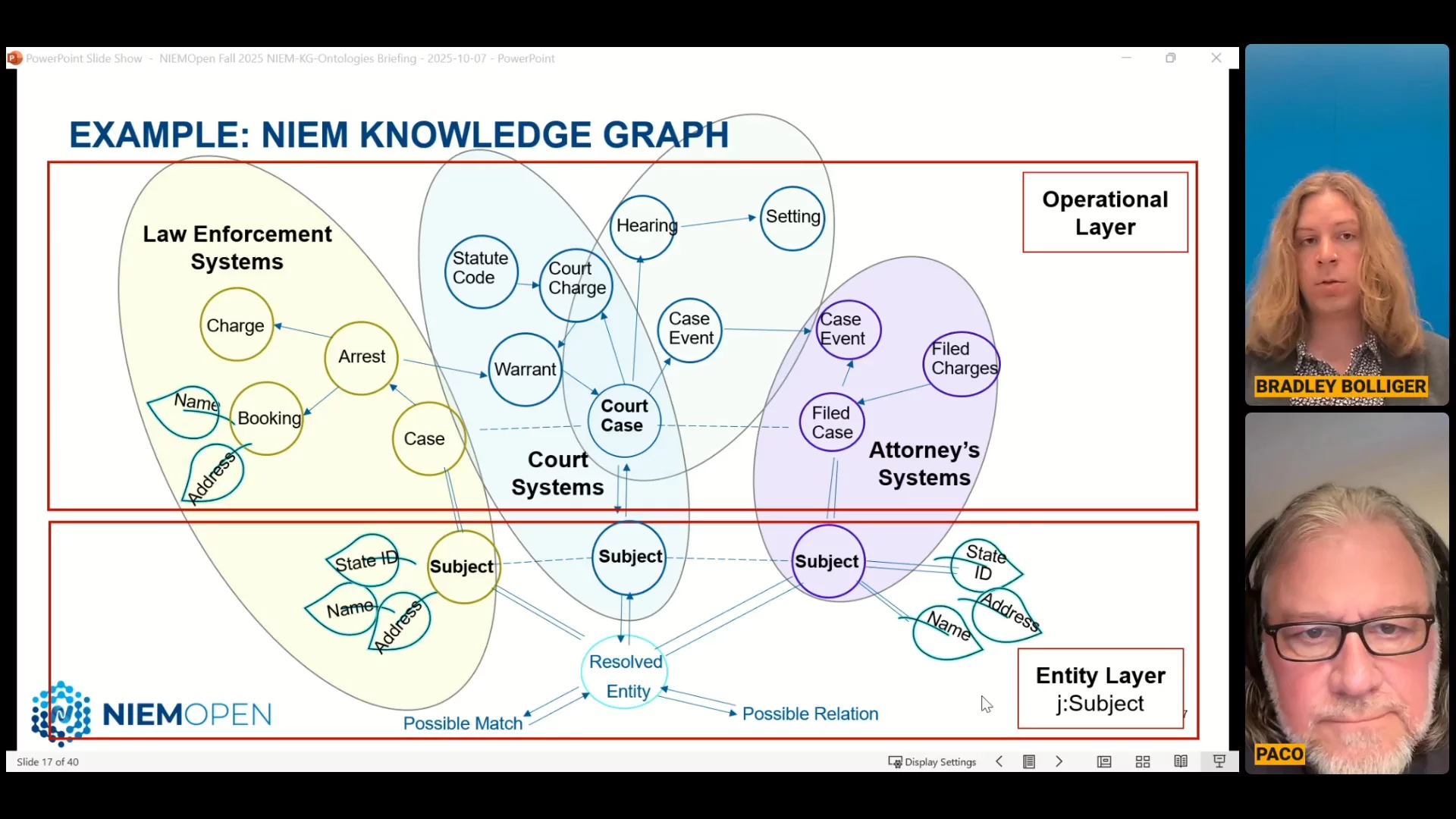
Bradley will also guide us on a tour through NIEMOpen, showing demos of how to generate JSON docs integrating information from different schema, and where entity resolution plays a vital role in these practices. We'll dive into one of the core value props near-term for AI adoption, where graph technologies and downstream AI apps help:
- return complex systems back to human scale
- connect critical data infrastructure
- meet the needs for collaborative data analytics in contemporary enterprise environments
Links:
EY Unified Justice Platform: https://www.ey.com/en_us/industries/government-public-sector/ey-unified-justice-platform
NIEM Open: https://niem.github.io/
NIEM 5.2 release notes: https://niem.github.io/niem-releases/5.2/
NIEM 5 Tools: https://niem5.org/
Speakers

Paco Nathan
Principal DevRel Engineer, Senzing
Paco Nathan leads DevRel for the Entity Resolved Knowledge Graph practice area at Senzing and is a computer scientist with +40 years of tech industry experience and core expertise in data science, natural language, graph technologies, and cloud computing. He's the author of numerous books, videos, and tutorials about these topics.

Bradley Bolliger
Manager, AI & Data, Ernst & Young
Bradley Bolliger (they/them) works in the AI & Data practice of Ernst & Young and serves as co-chair of the Technical Architecture Committee of NIEMOpen, an OASIS open standards body for data interoperability. Brad assists clients across various industries with optimizing data platform ecosystems, enhancing customer relationships, and leveraging advanced analytics tools and techniques in their digital transformation efforts. In addition to designing data platforms and AI/NLP systems, Brad has served in lead analyst roles for public sector information system modernization efforts, including contact center data ecosystems and integrated criminal justice system environments. Modernizing legacy information systems can be an arcane process with aging infrastructure, legacy data challenges, and limited funding relative to core operational concerns. Facilitating the connectedness of critical data infrastructure and meeting the collaborative analytical needs of our modern world require semantically-aligned information exchange across distributed systems.
NIEMOpen for Information Exchange: complex system modeling with knowledge graphs
01:02:18